
FOB is one of the most commonly used trade terms in car export from China — and one of the most misunderstood. Overseas dealers regularly receive FOB quotes from Chinese suppliers and assume that price covers everything up to their port. It does not. Understanding exactly what FOB includes, and what it leaves out, is the difference between accurately budgeting an import and getting an unwelcome surprise when the vessel arrives.
This guide breaks down a car FOB quote from China in plain terms: what the supplier covers, what you arrange on your side, and how to use an FOB price to calculate your true landed cost per vehicle. If you are new to sourcing from China, you may also want to read our guide on how to order ready stock cars from China, which covers the full buying process step by step.
Whether you are a first-time importer or an established dealer renegotiating with a new supplier, getting this breakdown right from the start saves you from budget shortfalls and delayed clearances at the destination port. Our ready stock vehicles page lists current FOB pricing from Nansha Port for available units.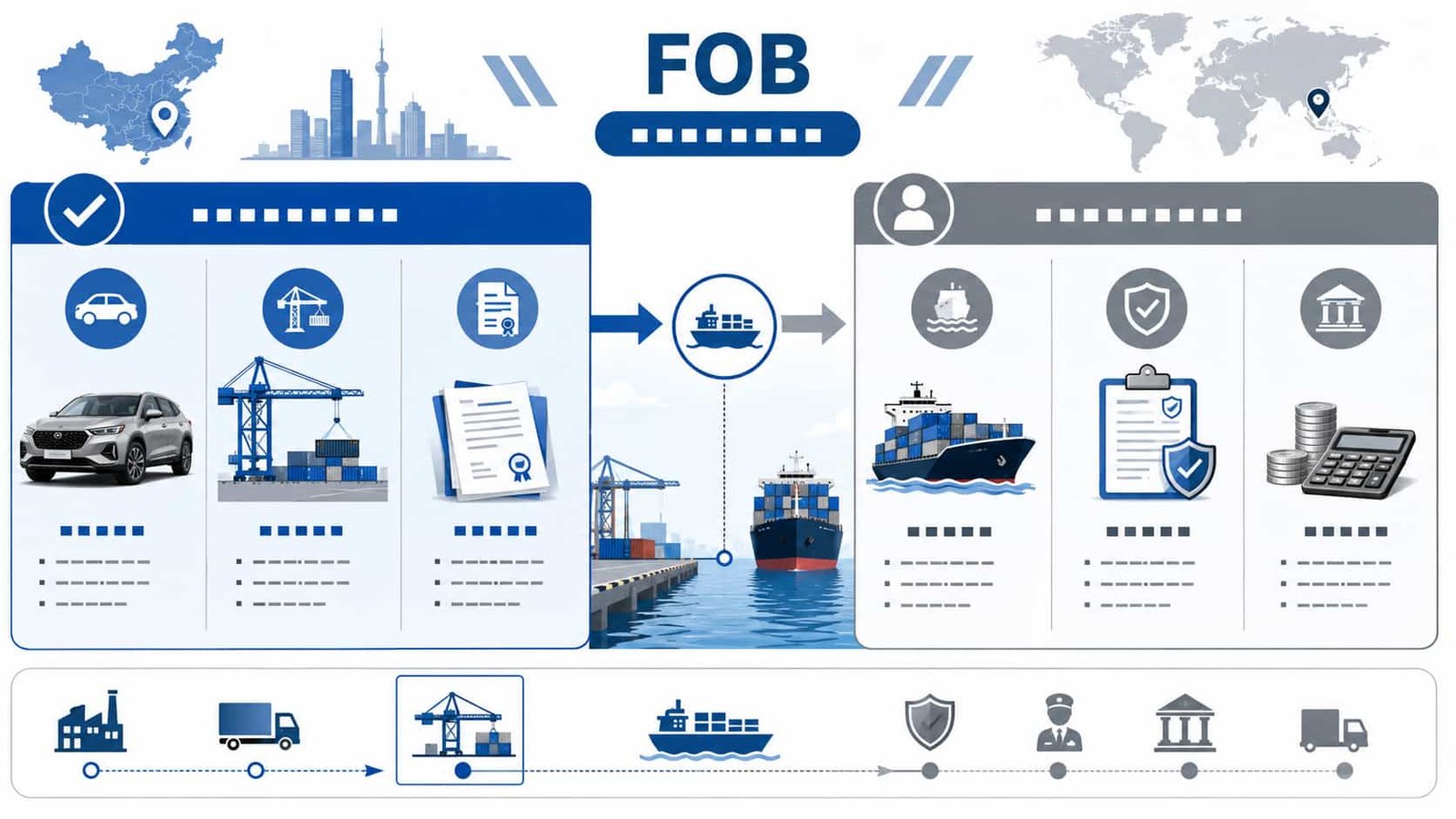
Key point: FOB — Free On Board — means the seller’s responsibility ends once the goods are loaded onto the vessel at the named port. Everything from that point forward is the buyer’s cost and risk.
What a Car FOB Quote Covers
When a Chinese car exporter quotes you a vehicle at, say, $14,800 FOB Nansha Port, that price covers a specific set of costs on the supplier’s side. For ready stock vehicles held at the supplier’s yard, this price is fixed at the time of inquiry and does not change between quote and order confirmation. Here is what is included:
- The Vehicle Itself
The largest component of the FOB price is the purchase cost of the vehicle — what the supplier paid to acquire it, plus their margin. For ready stock, this price is locked at inquiry and does not fluctuate between quote and order confirmation.
Note: For custom-sourced vehicles (not ready stock), prices can shift between quote and delivery if the market moves. This is one reason ready stock is preferred for dealers who need price certainty.
- Domestic Transport to the Port Yard
If the vehicle is held at a supplier yard away from the port, the FOB price includes the cost of transporting the vehicle to the port area. For RichingAuto, vehicles are held at our Guangzhou yard and moved to Nansha Port as part of the export process.
- Pre-Shipment Inspection
A reputable exporter includes a pre-shipment inspection in the FOB price. This covers photographing and documenting the vehicle before loading — exterior, interior, engine bay, odometer, and VIN. The inspection report is sent to the buyer before balance payment.
- Export Customs Clearance in China
All vehicles leaving China must go through Chinese customs export declaration. The cost of the customs agent, export duties (if applicable), and the official export declaration filing are included in the FOB price.
- Port Handling Charges at Nansha
Loading a vehicle into a container or onto a RORO vessel involves port handling fees — terminal charges, container stuffing, and ramp handling. These are paid by the supplier and included in the FOB price.
- Export Documentation Preparation
The supplier prepares the full set of export documents: Bill of Lading, Commercial Invoice, Packing List, Certificate of Origin, and Chinese Export Declaration. For a detailed breakdown of what each document is used for, see our FOB car export guide. Document preparation costs are included in the FOB price.
What a Car FOB Quote Does Not Cover
This is where many first-time importers get caught out. The FOB price stops at the ship’s rail at Nansha Port. Everything from that point to your destination is your cost to arrange:
- Ocean Freight: The cost of shipping the container or RORO space from Nansha Port to your destination port. This is booked and paid by your freight forwarder. Rates vary by route — Lagos, Mombasa, Jeddah, and Callao are all different freight markets.
- Marine Insurance: FOB terms transfer risk to the buyer once the goods are on board. Marine cargo insurance for the voyage is your responsibility. Most freight forwarders can bundle this with the freight booking. Skipping insurance on a $50,000+ container load is not advised.
- Import Duty at Destination: Every country charges import duty on vehicles based on value, age, engine size, or fuel type. This is your largest cost after freight and is paid to your destination country’s customs authority.
- Destination Port Charges: Also called THC (Terminal Handling Charges). These are port fees charged on arrival — container unloading, port storage, and handling. Charged by the destination port, not the Chinese supplier.
- Customs Clearance at Destination: Your local clearing agent charges a service fee to process the import declaration. This is separate from the import duty itself.
- Last-Mile Delivery: Moving the vehicle from the destination port to your lot is not included and is arranged locally after customs clearance.
For a deeper comparison of how FOB and CIF terms affect your total cost, read our dedicated article: FOB vs CIF car shipping for Africa.
Important: Some suppliers quote CIF (Cost, Insurance, Freight) instead of FOB. CIF includes ocean freight and insurance but gives you less control over the shipping arrangement. FOB is generally preferred by experienced importers because you appoint your own freight forwarder and negotiate freight rates directly.
How to Calculate Your Landed Cost from an FOB Quote
Landed cost is the total cost to get one vehicle from the Chinese supplier’s yard to your lot, ready for sale. This is the number that determines your actual margin — not the FOB price alone.
Key point: Landed Cost = FOB Price + Ocean Freight + Marine Insurance + Import Duty + Destination Port Charges + Customs Clearance Fee + Last-Mile Delivery
The proportions vary significantly by destination. Below is a worked example for a single SUV shipped from Nansha Port to Lagos, Nigeria. For a full breakdown of container loading costs and profit margins, see our car container loading and profit calculation guide. These figures are indicative — actual costs depend on current freight rates and your country’s duty regime.
Cost Component | Example (SUV to Lagos) | Notes |
FOB Price (Nansha) | $14,800 | Fixed at time of order confirmation |
Ocean Freight (40ft, per unit share) | $800–$1,200 | Varies by vessel and season |
Marine Insurance | $100–$180 | Typically 0.5–1% of cargo value |
Import Duty (Nigeria) | $2,000–$4,000 | Varies by vehicle age, engine size |
Destination Port Charges (Lagos) | $300–$500 | THC + port storage |
Customs Clearance Fee | $150–$300 | Local agent fee |
Last-Mile Delivery | $100–$300 | Port to your lot |
Total Landed Cost (Estimate) | $18,250–$21,280 | Before your margin |
The gap between the FOB price and your landed cost — roughly $3,500–$6,500 in this example — is what dealers must budget before pricing for resale. For market-specific breakdowns, see our Nigeria car import guide or our UAE car import guide.
Landed Cost Variables by Destination
Destination | Freight Cost Range (per unit, 40ft share) | Duty Structure |
Lagos, Nigeria | $800–$1,200 | 35% + levies on CIF value |
Mombasa, Kenya | $900–$1,300 | 25% duty + 16% VAT |
Jeddah, Saudi Arabia | $600–$900 | 5% duty (low) |
Dubai, UAE | $500–$800 | 5% duty (low) |
Callao, Peru | $1,100–$1,600 | ~6–12% duty |
Tema, Ghana | $850–$1,200 | 20% duty + levies |
Design tip: Always confirm your country’s current import duty rates with a local clearing agent before finalising your order. Duty rates change and can significantly affect your landed cost.
FOB vs CIF: Which Should You Request?
Some dealers ask whether they should request FOB or CIF pricing from a Chinese supplier. Both are legitimate Incoterms — the choice affects who controls the freight arrangement and who carries the risk during the voyage. For a detailed comparison focused on African routes, read our article on FOB vs CIF car shipping for Africa.
Factor | FOB | CIF |
Who books freight | Buyer’s freight forwarder | Supplier |
Who pays freight | Buyer (billed by forwarder) | Included in supplier’s price |
Risk transfer point | On board at origin port | At destination port |
Freight rate transparency | Full — you see the rate | Hidden in supplier’s margin |
Insurance control | Buyer arranges | Supplier arranges (often minimal) |
Recommended for | Experienced importers | First-time buyers needing simplicity |
Most established dealers prefer FOB because it gives them control over freight costs and the choice of shipping line. When a supplier arranges freight on your behalf (CIF), they often add a margin to the freight rate. Over multiple containers per year, this adds up.
What to Ask Your Supplier When Requesting a FOB Quote
To get a complete and comparable FOB quote from a Chinese car exporter, ask for the following information alongside the price. A professional supplier should be able to answer all of these:
- FOB port: confirm which port the FOB price is based on (Nansha, Guangzhou, Tianjin, etc.)
- Does the price include export customs clearance? it should
- Does the price include port handling and container stuffing? it should
- What export documents are provided? B/L, Invoice, Packing List, CO, Export Declaration
- What is the payment structure? standard is 30% deposit, 70% balance after inspection — see our guide on paying Chinese car suppliers safely
- Is the price fixed until order confirmation? especially important for ready stock
- What is the inspection process? photos and video before balance payment
For guidance on payment terms and how to protect yourself during the transaction, read our article on how to pay Chinese car suppliers safely.
Conclusion
A car FOB quote from China covers the vehicle, domestic transport, export customs clearance, port handling, pre-shipment inspection, and export documentation. It does not cover ocean freight, marine insurance, import duty, destination port charges, or customs clearance at your end. Understanding this split is fundamental to calculating your real landed cost and protecting your margins.
When you request a quote from RichingAuto, we provide an itemised FOB breakdown so you know exactly what is included. Browse our current ready stock listing for available units with FOB pricing from Nansha Port, or contact us on WhatsApp for a custom stock list within 24 hours.