How to Pay Chinese Car Suppliers Safely: A Complete Guide for Overseas Dealers
The standard 30/70 payment structure, T/T bank transfer best practices, red flags that signal fraud, supplier verification steps, and what to do if a dispute arises
Table of Contents
The single moment of greatest financial risk in importing vehicles from China is the moment you send money. Everything before that — finding a supplier, reviewing a stock list, negotiating a price — carries no financial exposure. The instant a deposit leaves your bank account, you are trusting that a stranger on the other side of the world will deliver what they promised. Most transactions complete without incident. Some do not, and the dealers who lose money almost always made the same handful of mistakes.
This guide covers exactly how to structure payments to minimise risk, the verification steps to take before you send any money, the specific red flags that should make you stop and reconsider, and what to do if something goes wrong. None of this is complicated — it is a small number of disciplined habits that, followed consistently, protect you from the overwhelming majority of fraud and dispute scenarios in this trade.
Core principle: Every protection in this guide flows from one rule: never give up your leverage before you have to. A deposit before inspection gives the supplier an incentive to deliver an honest inspection. A balance payment before inspection approval removes that incentive entirely. Structure every payment so the supplier always has more to gain from delivering correctly than from disappearing.
The Standard Payment Structure: 30% Deposit, 70% Balance
The industry-standard payment structure for Chinese vehicle export is a 30% deposit paid after order confirmation, followed by a 70% balance paid only after you have reviewed and approved a full pre-shipment inspection report. This structure exists because it balances risk fairly between buyer and seller — neither party is fully exposed at any point in the transaction.
| Payment Stage | Amount | Trigger Condition | What It Protects |
|---|---|---|---|
| Deposit | 30% of order value | After pro-forma invoice confirmed | Supplier commits resources to sourcing/preparing your vehicles |
| Balance | 70% of order value | After you approve full inspection report in writing | You only pay full price once vehicles verified to match order |
| Variant: smaller deposit | 10–20% | For repeat customers with established trust | Lower risk exposure once a track record exists |
| Variant: full payment | 100% upfront | Almost never appropriate — major red flag if demanded | None — eliminates your only leverage |
Important: Some suppliers, particularly for very small orders or used vehicles already in ready stock, may propose different splits. A 40/60 or even 50/50 structure is not inherently unreasonable for an established relationship. What matters is the principle: never pay the majority of the order value before you have independently verified the vehicles match what you ordered.
T/T Bank Transfer: How It Works and How to Do It Safely
Telegraphic Transfer (T/T) — a standard international bank wire — is the overwhelming standard for Chinese vehicle export payments. Understanding exactly how it works, and the specific precautions to take, prevents the majority of payment-related losses.
Before You Send Any Payment
- Verify the bank account name matches the company name exactly: the beneficiary name on the bank account must match your supplier’s registered company name. If the account is in a personal name, or a different company name than the one you have been dealing with, stop and ask why.
- Confirm payment details by phone or video call, not just email: email accounts get hacked. A supplier’s legitimate email can be compromised, and a fraudster can send you altered bank details that look identical to previous correspondence. Always verbally confirm bank details before a first payment, and re-confirm if bank details ever change mid-transaction.
- Use your own business bank account: never route payments through personal accounts, friends’ accounts, or informal money transfer services. This creates a clean paper trail that protects you in any dispute and is often required for customs documentation.
- Keep every transfer confirmation and SWIFT reference: save the SWIFT/MT103 confirmation for every payment. This is your primary evidence if a dispute or chargeback situation arises.
- Match the invoice currency and amount exactly: confirm whether pricing is in USD or RMB, and ensure your transfer amount matches the pro-forma invoice exactly — discrepancies cause delays and complications on both ends.
After You Send a Payment
- Request immediate confirmation of receipt: a legitimate supplier confirms receipt within 1–3 business days (international transfers typically take 2–5 days to clear). Silence for a week or more after a deposit is a warning sign.
- Get a receipt referencing your specific order: the confirmation should reference your invoice or order number, not just acknowledge “payment received.”
Red Flags: Signs You Should Not Send Payment
The vast majority of fraud in this trade follows a small number of recognisable patterns. If you see any of these, stop and investigate further before sending money:
| Red Flag | Why It Matters | What to Do |
|---|---|---|
| Demands 100% payment upfront | Removes all your leverage; legitimate suppliers accept 30/70 | Decline; walk away if they refuse to negotiate |
| Bank account name ≠ company name | Money may be going to an individual, not the registered business | Request written clarification; verify independently before paying |
| Urgency / pressure to pay immediately | Creates pressure that prevents proper verification | Slow down — legitimate deals don't require instant payment |
| Bank details change via email only | Classic sign of email compromise / BEC fraud | Verify by phone call to a known number — never just by replying to email |
| No verifiable business licence | Cannot confirm this is a real registered company | Request licence number; verify on gsxt.gov.cn before proceeding |
| Refuses video call or yard visit | Legitimate suppliers with real inventory have no reason to refuse | Request a video call showing the actual vehicles and yard |
| Price significantly below market | If a deal looks too good to be true, it usually is | Compare against multiple quotes; investigate the low price |
| Refuses inspection before balance payment | Removes your ability to verify vehicles before full payment | This alone should end the relationship |
Verifying a Supplier Before You Pay
Verification takes a few hours and can save you tens of thousands of dollars. This is not optional diligence for a first-time relationship — it should be standard practice for every new supplier, regardless of how professional their communication appears.
- Check the business registration: search the company name on gsxt.gov.cn (China’s National Enterprise Credit Information Publicity System). A legitimate exporter will be registered, and the registration will show company age, registered capital, and business scope.
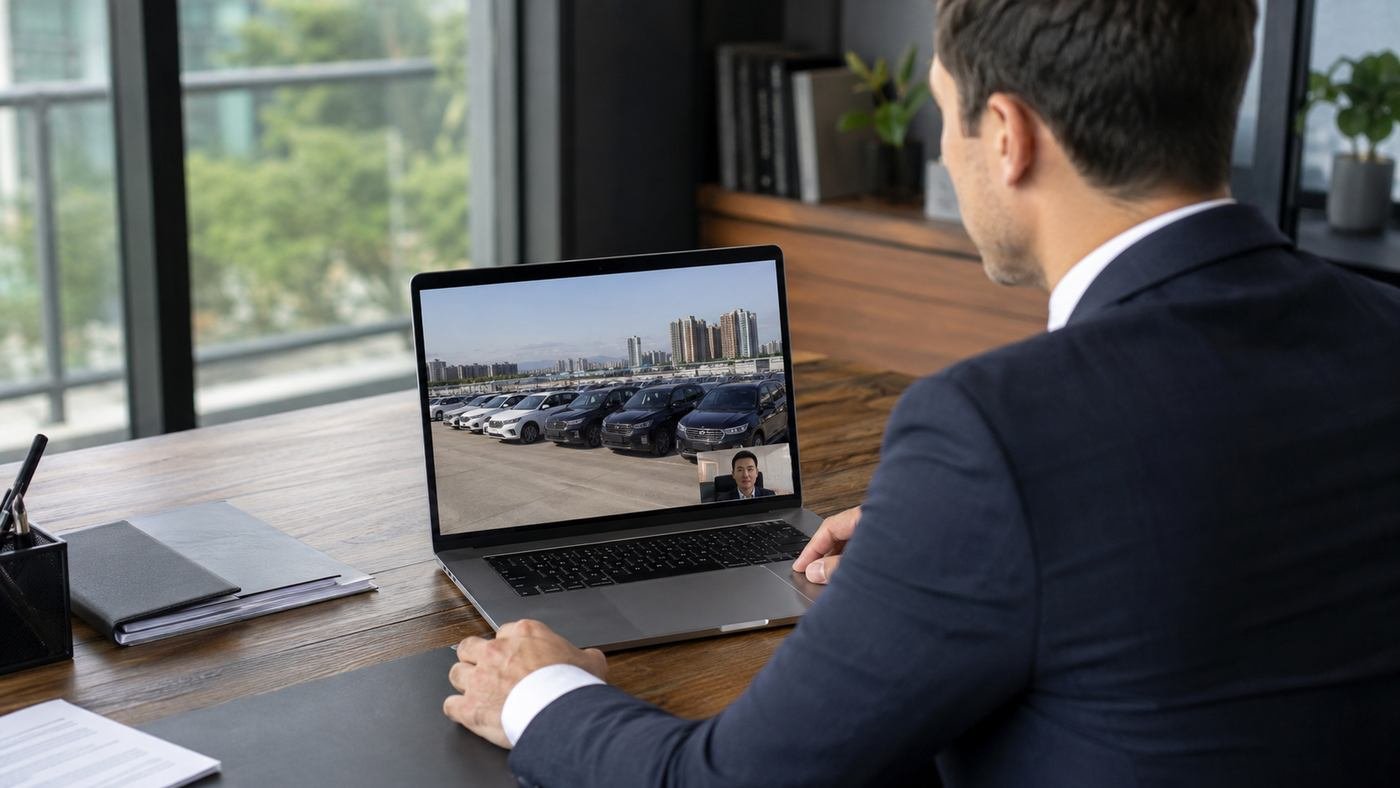
- Request a live video call: ask to see the actual export yard, the vehicles on your stock list, and ideally speak with more than one staff member. A real operation has no reason to refuse this.
- Ask for references: request contact details for two or three dealers in your region or similar markets who have used this supplier before. Call them directly and ask specifically about payment experience and whether deliveries matched what was promised.
- Search the company name plus “scam” or “complaint”: a basic web search often surfaces forum discussions or complaints if a supplier has a pattern of problems.
- Start small: for any new supplier relationship, place a small first order — one or two vehicles — before committing to a full container. The cost of testing the relationship is far lower than the cost of a failed large order.
Related guide: For a complete framework on identifying legitimate Chinese vehicle exporters from the outset, see our dedicated guide on how to find a reliable Chinese car exporter.
Pre-Shipment Inspection: Your Most Important Protection
The pre-shipment inspection, conducted after your deposit and before your balance payment, is the single most effective protection in the entire payment process. It is the point where you verify reality matches the stock list before committing the majority of your money.
| Inspection Element | What to Verify | Red Flag If Missing |
|---|---|---|
| VIN confirmation | VIN in photos matches VIN on invoice and any prior documentation | VIN mismatch or blurry/obscured VIN photos |
| Odometer reading | Photo of actual odometer matches stated mileage | Odometer photo missing or inconsistent with stated condition |
| Exterior condition (all angles) | Full walk-around video or photo set, including any damage | Only a few curated photos; refusal to show all angles |
| Interior condition | Photos of seats, dashboard, infotainment functioning | No interior photos provided |
| Engine bay and undercarriage | Photos showing no major leaks, damage, or non-standard repairs | Refusal to show engine bay or undercarriage |
Critical rule: Never pay the 70% balance until you have personally reviewed the inspection report and confirmed in writing that you approve it. This single discipline prevents the large majority of disputes in this trade. For the complete inspection checklist, see our pre-shipment inspection guide.
What to Do If a Payment Dispute Arises
- Act immediately: if a supplier goes silent after a deposit, or delivers something materially different from what was agreed, contact your bank within hours, not days. Some fraud recovery mechanisms have short windows.
- Contact your bank’s fraud department: for T/T transfers, recall requests are possible but time-sensitive — the longer you wait, the lower the chance of recovery. Provide your SWIFT reference immediately.
- Gather all documentation: every email, invoice, payment confirmation, and inspection report. This is essential whether you pursue bank recovery, legal action, or simply want to warn other dealers.
- Report to relevant authorities: if the amount is significant, file a report with your local police, and consider reporting the company to Chinese authorities through the relevant trade or commerce channels.
- Document and share with the dealer community: posting verified details of a fraudulent supplier in dealer forums and groups protects other importers from the same scheme.
Realistic expectation: Recovery of funds sent via international wire transfer to a fraudulent party is difficult and often unsuccessful, particularly once funds have moved beyond the initial receiving account. This is precisely why prevention through verification and structured payments matters far more than recovery after the fact. Treat every dollar sent as potentially gone the moment it leaves your account, and structure your payments so that the amount genuinely at risk at any one time is one you could absorb.
Conclusion: Discipline, Not Complexity
Paying Chinese vehicle suppliers safely is not a complicated process — it is a small number of disciplined habits applied consistently. Structure payments as 30% deposit and 70% balance after inspection approval. Verify any new supplier’s business registration and request a video call before sending money. Never let urgency pressure you into skipping verification steps. Confirm bank details by phone, not just email. And treat the pre-shipment inspection as the non-negotiable checkpoint it is — the point where you confirm reality matches the order before committing the bulk of your capital.
The dealers who have problems in this trade are almost never the ones who follow this discipline. They are the ones who skip verification because a deal seems urgent, or who pay in full because a supplier seemed trustworthy in conversation. Trust is built through verified track record, not through how professional an email sounds.
RichingAuto operates on the standard 30/70 structure with full pre-shipment inspection on every order, and we are happy to provide references from existing dealer customers. Contact us on WhatsApp with any questions about our payment process, or browse our current ready stock inventory to see what is available now. For the complete process from inquiry to delivery, see our guide to starting a car import business from China.