
How to Start a Car Import Business from China: A Complete Step-by-Step Guide
How much capital you need, which market to target, how to find a reliable supplier, the complete order process, and the mistakes that sink first-time importers
Table of Contents
Importing cars from China and selling them in Africa or the Middle East is one of the most accessible vehicle trading businesses available to new dealers. The barriers to entry are lower than many people assume — you do not need a large dealership, an established brand relationship, or years of automotive industry experience to place your first container. What you do need is a clear understanding of the process, realistic capital expectations, and the discipline to avoid the mistakes that cause most first-time importers to lose money on their initial order.
This guide covers everything from the beginning: what a car import business actually looks like in practice, how much capital you need to start, which markets and models to target first, how to find and verify a Chinese supplier, the complete step-by-step order and shipping process, how to handle customs in your destination market, and the specific mistakes that experienced importers have learned to avoid. By the end, you will have a clear picture of whether this business is right for you and exactly what your first order should look like.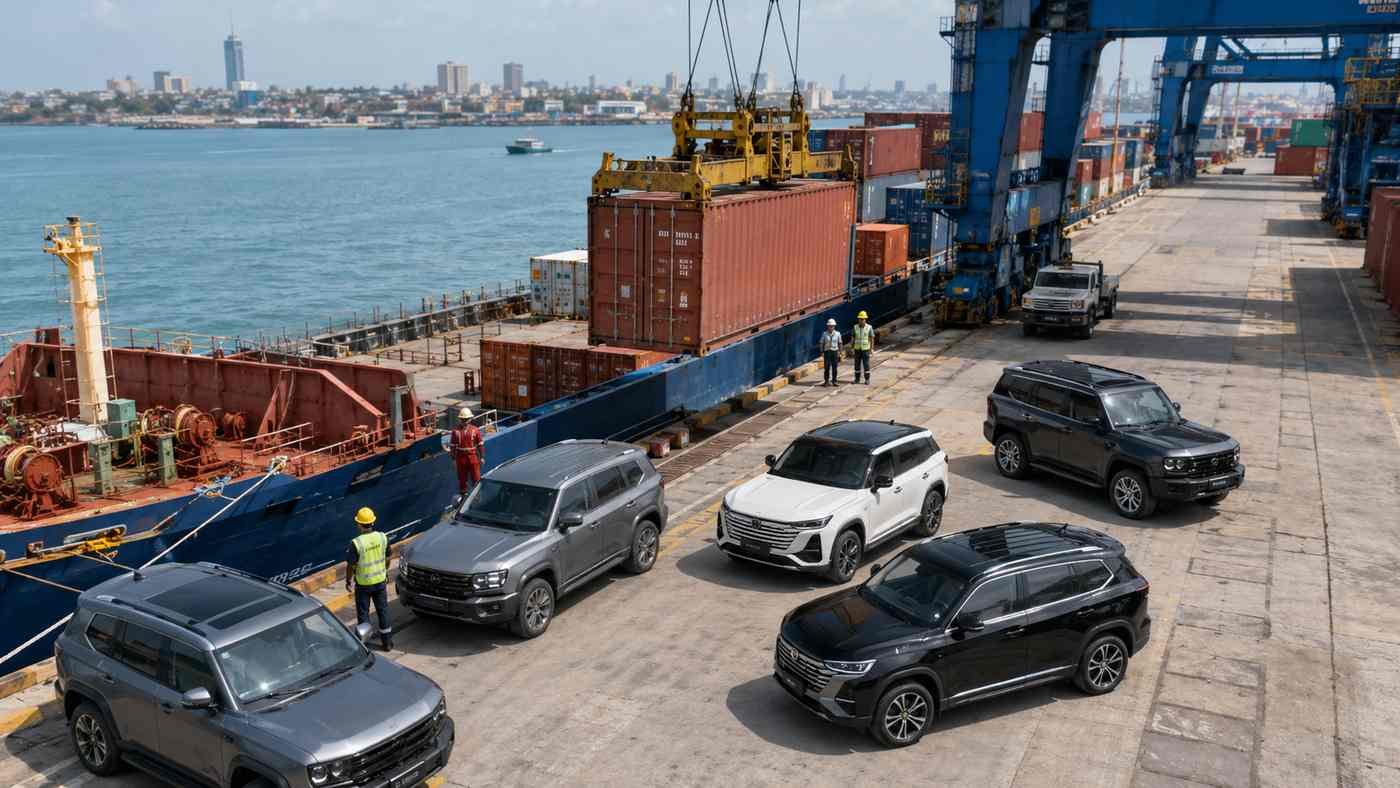
Who this guide is for: This guide is written for people considering their first car import order from China — whether you are a new dealer, an entrepreneur looking to enter the automotive trade, or an existing dealer who currently sources from Japan or the Gulf and wants to understand the China supply chain. If you have already completed several orders, our individual market guides (UAE, Saudi Arabia, Nigeria, Kenya, Ghana, South Africa) will be more directly useful.
What a Car Import Business from China Actually Looks Like
Before getting into the mechanics, it is worth being clear about what this business model involves in practice — because the reality is different from how it is often described online.
The Basic Model
You source used or new Chinese vehicles from Guangzhou, China (primarily from the Nansha Port area), ship them in 40-foot containers to your destination market, clear customs, and sell them from your lot. The margin is the difference between your total landed cost (FOB price + freight + insurance + import duty + port handling + last-mile delivery) and your retail selling price.
Three Business Models
| Model | Description + Best For | Starting Capital | Risk Level |
|---|---|---|---|
| Single container importer | 3–5 vehicles per container, sell from own lot or network. Best for: new importers testing the market | $25,000–$60,000 per container | Medium — manageable if first order is well planned |
| Regular volume dealer | 2–4 containers per month, established lot and customer base. Best for: dealers with existing network | $100,000–$300,000 working capital | Medium — volume reduces per-unit cost |
| Wholesale / sub-dealer supply | Import in bulk, supply other dealers. Best for: experienced importers with dealer relationships | $200,000+ working capital | Lower per-unit margin; higher volume |
Key point: Most first-time importers should target the single container model — 3–5 vehicles per 40ft HC container, targeted at a specific market segment they already understand. Trying to build a wholesale operation before understanding the supply chain and your market is the fastest way to lose a significant amount of money.
Step 1: Choose Your Market Before You Choose Your Cars
The most common mistake new importers make is starting with the vehicles — finding a supplier, picking models, and only then thinking about where and how to sell. The correct order is the opposite: start with your market, understand your buyers, then work backwards to identify which vehicles will sell at the right price.
| Market (Drive Side) | Best Entry Models | Key Regulation | First Container FOB |
|---|---|---|---|
| Nigeria (LHD) | Changan CS55/CS75, Jetour X70, BYD Dolphin | No age restriction; 35% duty | $30,000–$50,000 |
| Ghana (LHD) | Changan CS55, Jetour X70, Geely Coolray | 10-year age limit; ~40–50% duty | $28,000–$45,000 |
| Kenya (RHD required) | Haval H6 RHD, BYD Atto3 RHD | 8-year age limit; PVoC required; ~70–80% duty | $32,000–$55,000 |
| South Africa (RHD required) | BYD Atto3 RHD, Haval H6 RHD | SABS required; 25% duty + 15% VAT (reclaimable) | $35,000–$60,000 |
| UAE (LHD) | BYD Atto3, Changan CS75, Jetour T2, ZEEKR 7X | No age restriction; 5% duty only | $35,000–$70,000 |
| Saudi Arabia (LHD) | BYD Atto3, Changan CS75 2.0T, Jetour T2/X90 | SASO required; 5% duty + 15% VAT; 5-yr age limit | $38,000–$65,000 |
| Algeria (LHD) | Changan CS55/CS75 new, Jetour X70/X90 new | 3-year age limit (new only); 55–65% duty; licence required | $40,000–$70,000 |
Note: For full import regulations, duty rates, port information, and step-by-step processes for each market, see our dedicated market guides: UAE, Saudi Arabia, Kenya, Ghana, South Africa.
Step 2: Understand How Much Capital You Actually Need
Capital requirements are the most common thing new importers underestimate — not just the cost of the vehicles, but the full cost of running the business through to when you receive payment from your buyers. Here is a realistic breakdown:
| Cost Item | Typical Range | Notes |
|---|---|---|
| Vehicle FOB cost (3–4 units) | $25,000–$55,000 | Main working capital requirement |
| Ocean freight (per container) | $2,500–$5,000 | Varies by destination and season |
| Marine insurance | $150–$400 | ~0.5% of CIF value |
| Import duty and taxes | 20–80% of CIF value | Biggest variable — know your market before ordering |
| Port handling + clearing + last-mile | $500–$2,000 per vehicle | Local costs at destination |
| Working capital buffer (while selling) | $5,000–$15,000 | Cover costs while inventory is unsold |
| Emergency / contingency | $3,000–$8,000 | Customs disputes, repairs, delays |
| Total (low — LHD, lower duty) | ~$45,000–$60,000 | Nigeria / Ghana / UAE |
| Total (high — RHD or high duty) | ~$80,000–$120,000 | Kenya / Algeria / Saudi Arabia |
Important: The import duty and taxes at your destination are often the largest single cost after the vehicles themselves. In Nigeria or Ghana (~40–50% effective rate), a $15,000 FOB vehicle costs you roughly $6,000–$7,500 in duty. In Kenya (~70–80% effective rate on CRSP value), the same vehicle can cost $12,000–$15,000 in duty. Calculate your full landed cost before making any commitment to a supplier.
Step 3: Find and Verify a Chinese Vehicle Supplier
Your Chinese supplier is the most important relationship in this business. A reliable supplier who provides accurate descriptions, honest inspection reports, and correct documentation will make your business profitable. A dishonest or incompetent supplier will cost you more than any single bad vehicle — they will cost you your business.
Types of Chinese Vehicle Suppliers
| Supplier Type | Description | Risk Level | How to Identify |
|---|---|---|---|
| Licensed export company | Registered business with export licence, verifiable address, multiple staff | Low | Registered on gsxt.gov.cn; business licence visible; professional response |
| Individual trader / broker | Person acting as middleman with no export licence | High | No business registration; personal WeChat only; no physical office |
| Domestic dealer as exporter | Chinese car dealer who exports occasionally, not a specialist | Medium | Has vehicles but limited export documentation experience |
| Large wholesale exporter | Established export operation — large yard, multiple staff, clear processes | Low | Nansha/Guangzhou base; references available; consistent stock lists |
How to Verify a Chinese Supplier Before Sending Money
- Check business registration: search the company name on gsxt.gov.cn (China’s national business registry). A legitimate export company will be registered. If they cannot provide their business licence or registration number, stop.
- Request a video call: a real supplier will show you their yard, their vehicles, and their team. An individual running a scam typically cannot do this. Use this call to see the stock list vehicles in person.
- Ask for references: request contact details for two or three dealers they have supplied in your target market. Call them. Ask specifically about document accuracy, inspection honesty, and whether vehicles matched descriptions.
- Start with a small order: never place a full container order with a supplier you have not used before. Start with one or two vehicles to verify the process before scaling up.
- Never pay 100% upfront: the standard payment structure is 30% deposit before inspection and 70% balance after your inspection report is approved. Any supplier demanding full payment before inspection is a red flag.
Key point: For a complete guide to identifying legitimate Chinese vehicle exporters and the specific red flags to watch for, see our article on how to find a reliable Chinese car exporter.
Step 4: Choose the Right Models for Your First Order
Your first container should contain models that are easy to sell, well understood by buyers in your market, and priced to move within 30–60 days of arrival. This is not the time to import unusual or premium models that require extended buyer education. Here are the strongest first-order choices by market:
| Market | Best First-Order Models | Why These Models | FOB Range (per unit) |
|---|---|---|---|
| Nigeria | Changan CS55 Plus (3–4yr), CS75 Plus (3–4yr) | Established awareness; proven in market; easy to explain to buyers | $8,000–$14,000 |
| Ghana | Changan CS55 (3–4yr), Jetour X70 (3–4yr), Geely Coolray (3–4yr) | Price-sensitive market; hit right retail points; growing recognition | $8,000–$13,000 |
| Kenya (RHD) | Haval H6 RHD (2–3yr), BYD Atto3 RHD (1–2yr) | Easiest RHD Chinese models to source; official market stock | $14,000–$19,000 |
| South Africa (RHD) | BYD Atto3 RHD (1–2yr), Haval H6 RHD (2–3yr) | Both have official SA dealer presence; SABS clearance simpler | $14,000–$20,000 |
| UAE | BYD Atto3 (1–2yr), Changan CS75 (2–3yr), Jetour X70 (2–3yr) | Low duty means more model flexibility; proven Dubai retail margins | $12,000–$18,000 |
| Saudi Arabia | Changan CS75 Plus (2–3yr), Jetour X90 (2–3yr), BYD Atto3 (1–2yr) | 7-seat demand strong; 2.0T preferred; growing brand acceptance | $13,000–$20,000 |
Key point: For your first order, mix 2–3 models rather than loading all one model. This tests market response across different price points and body styles. A typical strong first container for Nigeria: 2× Changan CS75 Plus + 2× Changan CS55 + 1× Jetour X70. See our guide on how to fill a 40ft container with mixed models for loading configurations.
Step 5: The Complete Order Process — From Inquiry to Delivery
Once you have identified your market, set your budget, chosen a supplier, and decided on models, the order process follows a consistent structure. Here is the complete sequence:
| Step | Action | Timeframe | Key Points |
|---|---|---|---|
| 1 | Send specific inquiry: model, year/km, quantity, destination, FOB budget | Day 1 | Be specific — "CS75 Plus 2022–2023, under 40,000km, LHD, Lagos, max $13,000 FOB" |
| 2 | Receive stock list with photos, year, mileage, FOB price | Day 1–2 | Confirm year, odometer, and visible condition carefully |
| 3 | Select vehicles; request pro-forma invoice | Day 2–3 | Check all details on pro-forma match your order exactly |
| 4 | Pay 30% deposit via T/T bank transfer | Day 3–5 | Use business account; document every transfer |
| 5–6 | Receive full pre-shipment inspection (photos + video + VIN) | Day 7–14 | Most important decision point — approve only if everything matches |
| 7 | Pay 70% balance after approving inspection | Day 10–18 | Never pay balance before inspection is approved |
| 8 | Container loading at Nansha; Bill of Lading issued | Day 14–22 | Request loading photos; confirm container number |
| 9 | Receive original shipping documents; courier BL | Day 18–25 | Original BL required to release container — keep safe |
| 10 | Vessel transit to destination port | Day 22–60 | UAE ~18 days; Kenya ~28 days; Nigeria ~30 days; SA ~25 days |
| 11 | Clearing agent handles customs + duty payment | Day 55–80 | Brief agent before vessel arrives; have duty funds ready |
| 12 | Transport vehicles from port to your lot | Day 60–85 | Arrange logistics in advance |
| 13 | Pre-sale preparation, pricing, photography, retail | Day 65–90+ | Target sale within 60 days of landing for healthy cash flow |
Note: Total timeline from deposit to first sale is typically 70–100 days for most markets. Plan your cash flow accordingly — you will have significant capital tied up for 2–3 months before generating any returns. For the full pre-shipment inspection checklist, see our inspection guide. For a detailed breakdown of what your FOB quote includes, see our FOB quote guide.
Realistic Profit Margins: What to Expect on Your First Order
New importers often overestimate margins because they calculate based on FOB price versus retail price without fully accounting for all the costs in between. Here is a realistic margin calculation for a first order:
| Cost / Revenue Item | Nigeria (3yr CS75 Plus) | UAE (3yr Changan CS75) | Kenya (3yr Haval H6 RHD) |
|---|---|---|---|
| FOB Price (Nansha) | $12,000 | $12,000 | $15,000 (RHD premium) |
| Ocean freight + insurance | $1,175 | $765 | $1,040 |
| Import duty + taxes | $5,400 (~40%) | $645 (5% only) | $12,000+ (~70% CRSP) |
| Port + clearing + last-mile | $1,000 | $650 | $1,100 |
| Total Landed Cost | ~$19,575 | ~$14,060 | ~$29,140+ |
| Target Retail Price | $26,000–$30,000 | $20,000–$23,000 | $38,000–$44,000 |
| Gross Margin per Unit | $6,425–$10,425 | $5,940–$8,940 | $8,860–$14,860 |
| Gross Margin % | ~25–40% | ~30–40% | ~23–34% |
Reality check: Gross margin is not profit. You still need to deduct lot rental, staff costs, any pre-sale preparation costs, marketing, and your own time. On a 4-vehicle container with $7,000 average gross margin per unit, your total gross is $28,000. After overheads of $3,000–$5,000 for the period, net profit on your first container might be $20,000–$25,000. That is a meaningful return on a $45,000–$60,000 investment — but only if all four vehicles sell within 60 days of landing.
10 Mistakes That Sink First-Time Car Importers
Every experienced importer has made at least some of these mistakes. Learning them before your first order is significantly cheaper than learning them after.
| Mistake | What Happens | How to Avoid It |
|---|---|---|
| 1. Paying 100% deposit to new supplier | Supplier disappears or delivers wrong vehicles; no leverage | 30% deposit before inspection; 70% balance after approval only |
| 2. Skipping pre-shipment inspection | Vehicles arrive with damage, wrong spec, or higher mileage | Always request full photo + video; pay balance only after approval |
| 3. Underestimating import duty | Landed cost $10,000–$20,000 higher than expected; margin wiped | Calculate full landed cost including all taxes before ordering |
| 4. Importing unknown models | Vehicles unsold for months; capital locked up | Start with proven brands (Changan, Haval, BYD) first |
| 5. Buying wrong drive side | LHD vehicles in Kenya/SA cannot be road-registered — total loss | Always confirm drive side requirement before ordering |
| 6. Over-age limit vehicles | Vehicles seized or refused registration at destination | Know your market age limit exactly; confirm year from supplier |
| 7. No clearing agent in advance | Demurrage charges accumulate daily while agent is found | Appoint clearing agent before vessel departs China |
| 8. Using personal bank account | Bank compliance issues; payment delays; customs problems | Use a business bank account for all import payments |
| 9. Too many vehicles before testing | Capital locked up; forced to discount; cash flow crisis | First order: max 4–5 units; scale only after market proven |
| 10. Single unverified supplier | Quality declines or first order was a one-time honeymoon | Always verify; build relationships with 2–3 suppliers in parallel |
Document Checklist: What You Need for Every Shipment
Every container requires a consistent set of documents. Missing or incorrect documents cause customs delays, additional fees, and in the worst cases, vehicles refused entry. Keep this checklist for every order:
| Document | Issued By | Required For | Critical Notes |
|---|---|---|---|
| Bill of Lading (original) | Shipping line | Container release at destination | Original only — not electronic. Must be couriered to you. |
| Commercial Invoice | Chinese supplier | Customs valuation; duty calculation | Must show correct FOB value, VINs, and your name as buyer |
| Packing List | Chinese supplier | Customs declaration | Lists all vehicles with VIN, year, make, model |
| Certificate of Origin | CCPIT China | Duty calculation; trade compliance | Must be issued before loading; ~$50–$150; arrange in advance |
| Export Declaration | Chinese Customs | Proof of legal export | Provided by your supplier |
| Vehicle Title / Registration | Chinese DMV authority | Ownership proof (used vehicles) | Critical — without this customs may impound vehicles |
| PVoC Certificate (Kenya only) | KEBS-approved body in China | Mandatory pre-export conformity (Kenya) | Must be arranged BEFORE loading; ~$150–$350 per vehicle |
| Insurance Certificate | Marine insurance provider | Customs clearance; proof of coverage | Arrange through freight forwarder or clearing agent |
Conclusion: Is a Car Import Business from China Right for You?
Starting a car import business from China is a realistic and potentially profitable venture — but it is not a simple one. The margin on each vehicle is meaningful, but it requires getting a significant number of things right simultaneously: choosing the right market and models, verifying your supplier, understanding your landed costs, having sufficient capital to cover the full cycle, and selling the vehicles quickly enough to generate returns before the next container needs to be funded.
The dealers who succeed in this business consistently share a few characteristics: they start small and scale only after the first container proves the model in their market; they treat supplier verification as seriously as they treat vehicle selection; and they calculate landed cost before they fall in love with a specific vehicle at a specific FOB price.
RichingAuto works with first-time importers as well as established volume dealers. If you are planning your first Chinese vehicle order, contact us on WhatsApp with your target market, estimated budget, and the models you are considering. We will provide a realistic stock list with full landed cost estimates for your market and tell you honestly whether your plan makes commercial sense before you commit any capital.
Browse our current ready stock inventory to see what is available now, or read our individual market guides for your target destination: